Posts

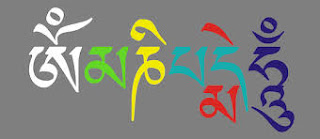
Colours of the spinning mantra
Image
  Approximate script, with some variations and possible errors: Hello good people. Welcome, or welcome back, to the Double Dorje podcast. I’m Alex Wilding, and today will be looking at all the rainbow colours of the mantra, sticking mainly with the famous Mani, as well as looking how they go round and round and round and round. In an earlier episode we looked a bit at the meaning of the Mani, and a couple of tunes that we might use for it. Today I want to look at some of its visual aspects, its colours, and its connection to the “six worlds”. The Mani is a particularly good example to use for this for three reasons: it is beautiful, it is popular, and it is accessible to people who haven’t received an appropriate empowerment. No rules need to be broken! Of course, if you can get an empowerment for this you certainly should. I’m not a great fan of online empowerments – perhaps they sort of work, but it all seems like very thin gruel – but a Chenrezi empowerment should be easier ...

Sadhana structure

Image
  Approximate script, with some variations and possible errors, of the Double Dorje episode at  the Double Dorje podcast Hello dear listeners, and welcome. I’m Alex Wilding and this is the Double Dorje podcast. The episodes in this podcast are generally not in any particular order, but this particular episode does pick up on something I touched on only very lightly in the episode about spooks, demons and helpful spiritual beings, and that is the overall structure of a sadhana practice. I mentioned then, that a lot of us beginning on vajrayana Buddhism in the modern world – and I was one of these – get started off on what are called “daily” practices. These are short sadhanas, just a handful of pages, designed to maintain a connection with a deity with which, traditionally, we would have already got some fairly full experience. At some stage then we might have a full-strength sadhana thrown at us, and we can easily feel that we just don’t know what to do with it. There seem...

Spooky beings - are they necessary?

 Approximate script, with some variations and possible errors: Hello, Hello, and welcome. Have you refreshed your knowledge of Defence Against the Dark Arts recently? If not, perhaps you shoul, as in this episode we are going to talk a tiny bit about magic, demons and dealings with the other side. I’m Alex Wilding and this is the Double Dorje podcast. A year or two ago I paid a visit to an abandoned house 10 minutes away from where I live. It’s a single story building down a slope a few yards from the main road. No neighbours. Overgrown gate, overgrown entrance path, front door fallen in. Pots and pans and empty cans still in the sink, filthy bedclothes still on the bed. I confess I felt too iffy about it to do my chöd practice in there, but took myself to the balcony outside to do the chant, beat the drum, blow the trumpet and so forth. But perhaps my lack of courage was a form of wisdom – I showed some pictures of the place to my teacher who is, amongst other things, an experie...

The Conundrum of Direct Introduction (podcast)

  Approximate script, with some variations and possible errors: Hello friends and all other sentient beings, who perhaps might have once been my mother! You are very welcome to the Double Dorje podcast. A conundrum: direct introduction to the true nature of the mind, also known as pointing out instructions! Ink gets spilt liberally in some corners of the internet about the importance of what is sometimes called "direct introduction". This term is particularly popular amongst those in the orbit of the "Dzogchen Community", which is/was the organization stemming from the activity of the late Namkhai Norbu. They have made it a centrepiece of their teaching structure, and that is where it is known as “DI”. DI is also referred to elsewhere as "pointing out instruction". This last phrase, or something similar, is perhaps more widespread. So first, why is it so important anyway? It might pay to look for a moment at what I think are the really radically di...

Manis and manis and...

 This is the approximate script, with errors and variations, of the Double Dorje episode at https://www.podbean.com/eas/pb-h4ymr-162c0b7 Hello friends and others! You are very welcome to the Double Dorje podcast. You won’t have got this far without noticing the music, if that’s the word, used for this Double Dorje intro and outro. Thousands upon thousands of mantras are used and recited in vajrayana Buddhism, but there is a handful such as the mantra of Guru Rinpoche and the Tara mantra that are particularly well known, and this one, commonly known simply as “the mani”, or as “the six syllable mantra”, is without question the best known of all. Later in this episode will take a look at a couple of tunes used for it, but first let’s take a moment to have a brief look at what it is. Put simply it’s the mantra of Chenrezi, also known under the Sanskrit name of Avalokiteshvara. (A quick reminder that I’ll put some of the words that might be unfamiliar into the description, so you can s...

The Double Dorje - itself.

Below is the approximate script, with possible errors, of the sixth episode in the Double Dorje podcast, released on 06 June 2024 at  the Double Dorje podcast . Hello, and let me begin by extending a very warm welcome to the Double Dorje podcast. The last episode of this podcast, the one about the meanings of “lama”, was a little longer, but I suspect this one will come out relatively short, although it does have two parts: the first part looks at the question of what is a double dorje, while the second one takes a look at what the Double Dorje was. So what is a double dorje? If the concept is completely new to you, the logo for this podcast should clue you in, especially if you note that the picture shows a ritual implement that can be held in one hand. Whereas the one on the logo has four “arms” so to speak, the standard dorje just has two. You can search the Internet easily enough for pictures. There is a sphere in the centre, and two sets of five prongs emerge from opposite sid...

Ngagpas - who are they?

Below is the approximate script of the third episode in the Double Dorje podcast, released on 15 May 2024 at  the Double Dorje podcast . Hello, and first of all a very warm welcome to the Double Dorje podcast. Ngagpa – that’s a kind of lay practitioner, isn’t it? Well, certainly, that’s kind of true, but that’s barely the half of it. First of all, the word: ngagpa is the nearest I can come to the pronunciation, although whether a real Tibetan would recognise the word without enough context is another matter! I won’t trouble you with the actual Tibetan spelling, which is a subject of its own to wrestle with if you want to learn Tibetan, so let’s just say that it’s N G A G P A. That’s two syllables, ngag and pa, and a simple translation is nothing more than “mantra person” or “mantra practitioner”. The female version has M A at the end instead of P A, and I’m happy to say that the number of female practitioners of this type is quite high, especially these days. I think (and somebody ...